Derivatives
(cod: P-49-43-6)
We say that a function \(f\) is differentiable or derivable at a number \(x_0\) in its domain if there exists
\begin{equation}\label{eq1} \lim\limits_{h \to 0} \dfrac{f(x_0 + h) - f(x_0)}{h}\end{equation}
and, in this case, the derivative of \(f\) at \(x_0\), denoted by \(f'(x_0)\), is given by the value of this limit, that is,
\[f'(x_0) = \lim\limits_{h \to 0} \dfrac{f(x_0 + h) - f(x_0)}{h}.\]
For a fixed value of \(h\), the ratio
\[\dfrac{f(x_0 + h) - f(x_0)}{h}, \]
appearing in the limit (\ref{eq1}) can be interpreted as the slope (inclination, or angular coefficient) of the secant line
passing through the points \(P = (x_0+h,f(x_0+h))\) and \(P_0 = (x_0,f(x_0))\). If \(f\) is differentiable
at \(x_0\), the line passing through \(P_0 = (x_0,f(x_0))\) with slope \(f'(x_0)\) is called the tangent line to the graph \(y = f(x)\) at \(P_0\).
In the animation below, the tangent line at \(P_0\) appears in lilac, in a case where \(x_0 = 1\).
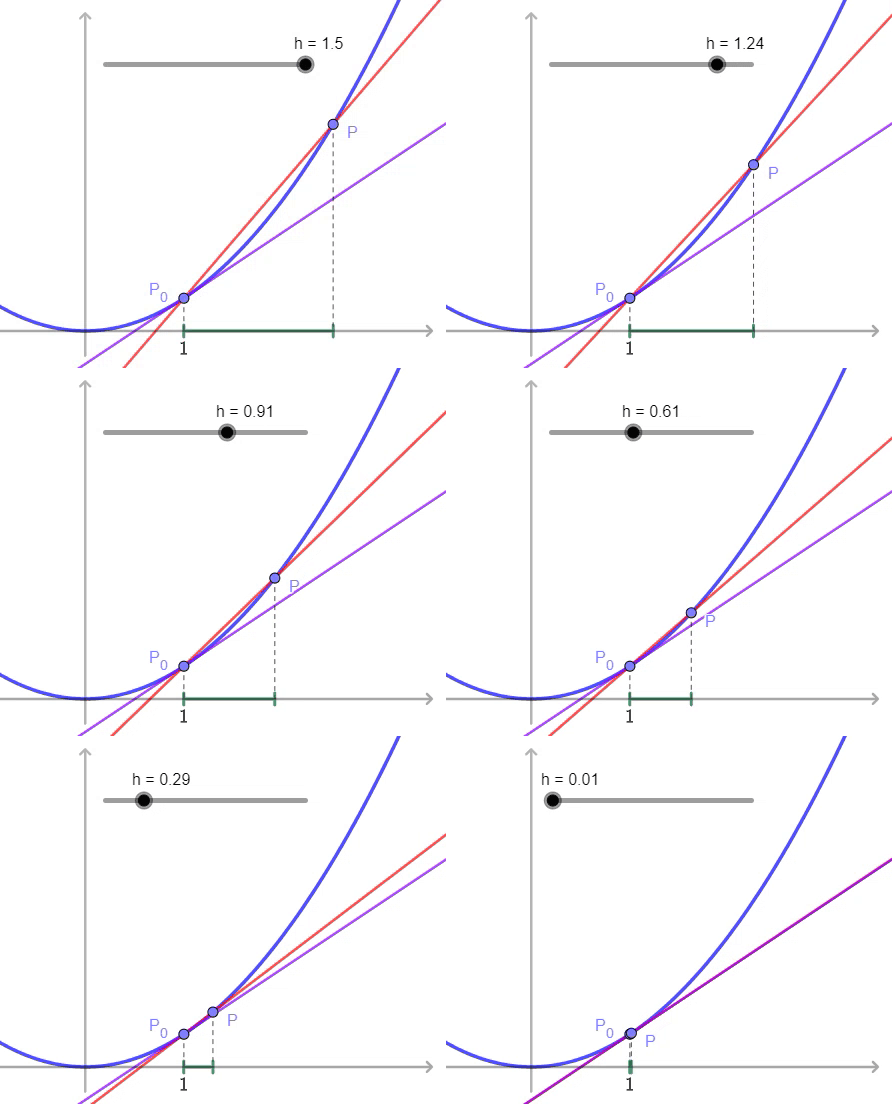
We observe that the limit in (\ref{eq1}) is equivalent to the limit
\begin{equation}\label{eq3} \lim\limits_{x \to x_0} \dfrac{f(x) - f(x_0)}{x - x_0},\end{equation}
that is, if one exists, then the other also exists and has the same value.
Given a function \(f: U \subset \mathbb{R} \to \mathbb{R}\), we can consider the derivative of \(f\) as the function
\[f'(x) = \lim\limits_{h \to 0} \dfrac{f(x+h) - f(x)}{h},\]
defined on the set
\[ \{x \in U: \ f \text{ is differentiable at } x\}.\]
Given a function \(y = f(x)\), we can use another way to denote its derivative, known as Leibniz notation (note that in this notation, we use \(\Delta x\) instead of \(h\)):
\[\dfrac{dy}{dx} = \lim \limits_{\Delta x \to 0} \dfrac{\overbrace{f(x+\Delta x) - f(x)}^{\Delta y}}{\Delta x}.\]
In fact, there are several ways to denote the derivative of a function \(y = f(x)\). We present some below:
\[f'(x) = \dfrac{dy}{dx} = \dfrac{d}{dx} \left(f(x)\right) = Df(x).\]
Leibniz notation emphasizes the derivative's nature as a rate of change. If \(y = f(x)\), note that
\[\dfrac{\Delta y}{\Delta x} = \dfrac{f(x+\Delta x) - f(x)}{\Delta x}\]
represents an average rate of change of \(y\) with respect to \(x\). The derivative arises when we let \(\Delta x\) approach zero.
Let us consider a more specific example. Suppose an object performs a rectilinear motion, so that its position can be described by
a function \(s = s(t)\) and represented graphically as a point on an axis. Note that
\[\dfrac{\Delta s}{\Delta t} = \dfrac{s(t+\Delta t) - s(t)}{\Delta t}\]
represents the average velocity over the time interval between the instants \(t\) and \(t + \Delta t\). In this case, the derivative of the position function represents
the instantaneous velocity of the object at the instant \(t\):
\[\small{v(t) = \dfrac{ds}{dt} = \lim\limits_{\Delta t \to 0} \dfrac{\Delta s}{\Delta t} = \lim\limits_{\Delta t \to 0}\dfrac{s(t+\Delta t) - s(t)}{\Delta t}.}\]
We have seen that, by differentiating a function, we obtain a new function, which is its derivative. We can then differentiate this new function, obtaining the second derivative or second derivative or derivative of second order. The second derivative of a function \(y = f(x)\) is denoted by
\[f''(x) \ \ \text{ or } \ \ \dfrac{d^2 y}{dx^2} \ \ \text{ or } \ \ f^{(2)}(x).\]
Proceeding inductively, if \(k\) is a natural number, we can consider the \(k\)-th derivative or derivative of order \(k\) of \(y = f(x)\), which we denote
by
\[f^{(k)}(x) \ \ \text{ or } \ \ \dfrac{d^k y }{dx^k}.\]
If \(s = s(t)\) describes the position of an object in rectilinear motion, then the second derivative \(s''(t)\) represents the instantaneous acceleration of the object at the instant \(t\).
Consider the following questions:
(1) If \(f\) is a differentiable function at a number \(x_0\) in its domain, then is \(f\) necessarily continuous at \(x_0\)? Conversely, if
a function \(f\) is continuous at a number \(x_0\) in its domain, then is \(f\) necessarily differentiable at \(x_0\)?
(2) If \(n\) is a natural number, determine the tangent line to the graph of the function \(f(x) = x^n\) at the point \(P_0 = (1,1)\).
(3) A projectile is launched vertically upwards. Its height, in feet, after \(t\) seconds, is given by
\(s = s(t) = 144t - 16t^2, \ t \in [0,9]\). Determine the velocity \(v(t)\) of the projectile (in feet per second) and the acceleration \(a(t)\) of the projectile (in feet per second squared).
Select the correct alternative: