Integrals and the Fundamental Theorem of Calculus
(cod: P-68-41-9)
The objective of this exercise is to present a proof for the first part of the Fundamental Theorem of Calculus.
Fundamental Theorem of Calculus (Part 1): Let \(f\) be a continuous function on an open interval \(I\) and let \(a \in I\). The function
\[F(x) = \int_a^x f(t) \, dt\]
is a primitive or antiderivative of \(f\) on \(I\), that is,
\[\dfrac{d}{dx}F(x) = f(x).\]
Note: Observe that the variable of the function \(F\) is the upper limit of integration. Inside the integral, to avoid confusion, we use another letter to represent the variable (called the dummy variable). Here we use \(t\), but any other letter could have been used.
Consider \(x \in I\) (in the figure below, we take \(x > a\), but the argument can be made in any case) and take \(h > 0\) such that
\(x+h\) still lies in \(I\).
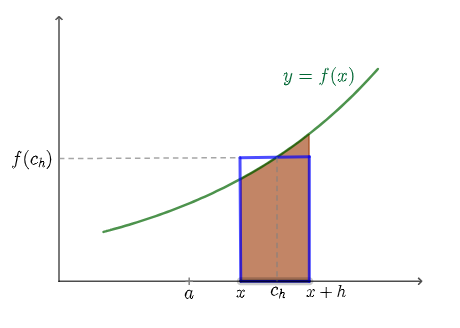
We have that
\[F(x+h) - F(x) = \int_x^{x+h} f(t) \, dt. \]
On the other hand, there exists \(c = c_h\) (which depends on \(h\)) between \(x\) and \(x+h\) such that
\[\int_x^{x+h} f(t) \, dt = f(c_h)h. \]
In the case where \(f\) is positive, this information means, geometrically,
that for a certain \(c_h\), the area of the brown strip coincides with the area of the rectangle of height \(f(c_h)\) and base \(h\).
Therefore,
\begin{eqnarray*}& & \lim\limits_{h \to 0^+} \dfrac{F(x+h) - F(x)}{h}
\\ & & \\ &=& \lim\limits_{h \to 0^+} f(c_h) = f(x),
\end{eqnarray*}
since \(c_h \longrightarrow x\) when \(h \to 0^+\) and \(f\) is continuous on \(x\).
We can use the same argument for the other lateral limit, which then allows us to conclude
that
\[F'(x) = \lim\limits_{h \to 0} \dfrac{F(x+h) - F(x)}{h} = f(x),\]
as we wanted to demonstrate.
Note: Part 1 of the Fundamental Theorem of Calculus states that any continuous function on an open interval has a primitive. Moreover,
the theorem provides an expression for such a primitive through an integral.
Note: According to the theorem, we can write
\[ \dfrac{d}{dx} \int_a^x f(t) \, dt = f(x).\]
Note: If \(f: [a,b] \to \mathbb{R}\) is continuous on the compact interval \([a,b]\) and \(F(x) = \int_a^x f(t) \, dt\), the same argument
proves that \(F\) is differentiable on \((a,b)\) (with \(F'(x) = f(x)\)) and has a right-hand derivative at \(a\) and a left-hand derivative at \(b\), thus being
continuous on \([a,b]\).
We then have some questions?
(1) Why is the statement in brown valid?
(2) What result guarantees the validity of the phrase in blue?
(3) What is the derivative of the function below?
\[F(x) = \int_0^x e^{-t^2} \, dt\]