Applications of Integration
(cod: P-77-50-5)
Buffon's Needles: Consider a floor made of planks \(L\) centimeters wide. When throwing a needle of length \(l < L\) onto the floor, what is the probability that the needle crosses a joint?
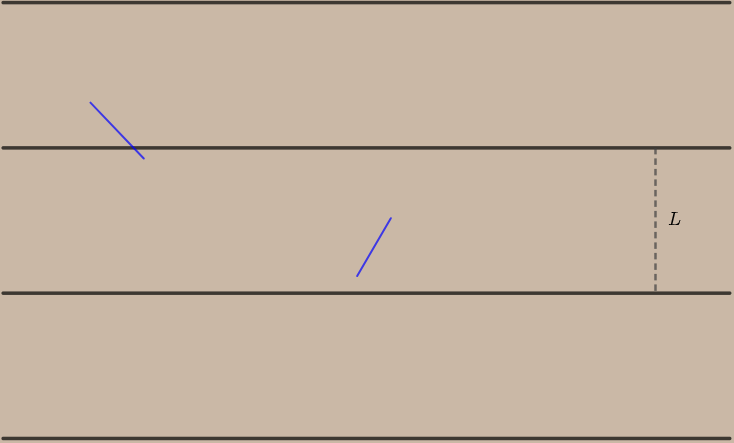
Let \(D\) denote the distance from the center of the needle to the nearest line (joint). Now, consider the normal line passing through the center of the needle, and let \(\theta\) denote the smallest angle formed between the needle and this normal. The figure below illustrates the situation for two distinct throws.
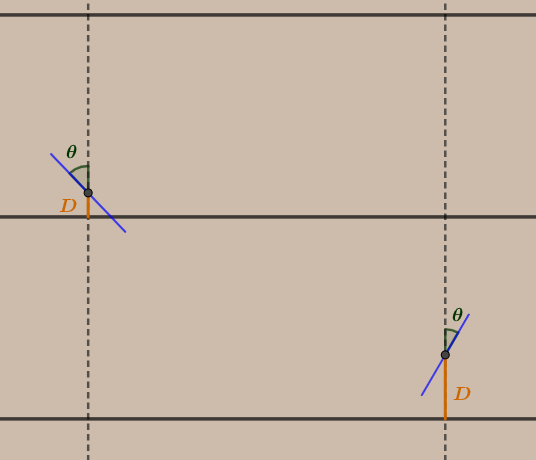
From a throw, we can then observe \(\theta\) and \(D\), where we necessarily have
\[0 \leq \theta \leq \pi/2 \ \ \ \text{ and } \ \ \ 0 \leq D \leq L/2.\]
That is, the result of a throw can be seen as a random choice of a point \((\theta,D)\) in the rectangle below.
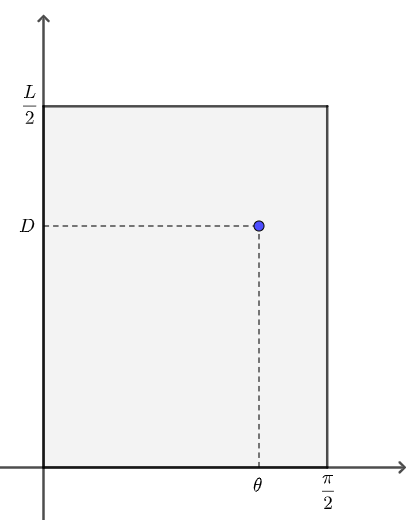
Assume that the probability is uniformly distributed in this rectangle, meaning that the probability \(P_W\) of the point obtained after a throw being in a given region \(W\) of this rectangle is proportional to the area of \(W\). Or equivalently,
\[P_W = \dfrac{\text{Area of }W}{\left(\pi L/4\right)},\]
where the denominator is the area of the rectangle. Now note that the needle will cross a line exactly when
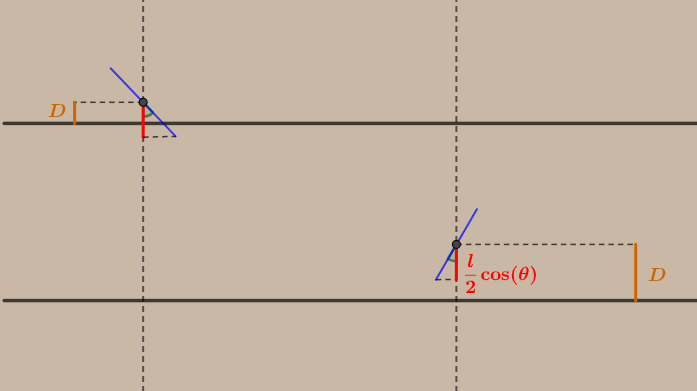
\[D \leq \dfrac{l}{2}\cos(\theta),\]
as indicated in the figure below.
Therefore, the needle will cross a line exactly when the pair \((\theta,D)\) is in the pink region indicated in the figure below.
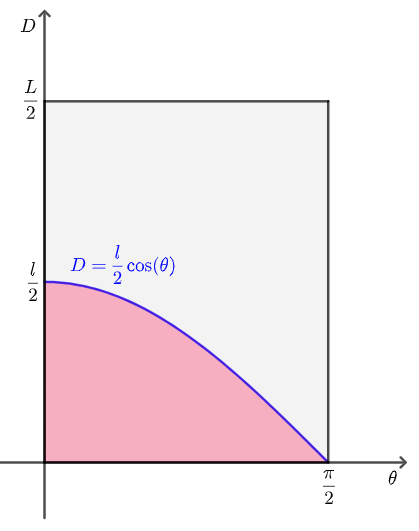
We can then conclude that the probability of the needle crossing a line after a throw is equal to: