Limits and Continuity
| Site: | DICA Project |
| Course: | Guest Area |
| Book: | Limits and Continuity |
| Printed by: | Usuário visitante |
| Date: | Thursday, 24 September 2026, 7:05 AM |
(cod: P-44-15-9)
Consider the function \(f(x) = x^2/3\) and let \(P_0\) be the point on the graph of \(f\) whose first coordinate is equal to \(1\). Given \(h \ne 0\), consider the point \(P\) on the graph of \(f\) whose first coordinate is equal to \(1 + h\), and denote by \(\varphi(h)\) the slope of the line passing through the points \(P_0\) and \(P\).
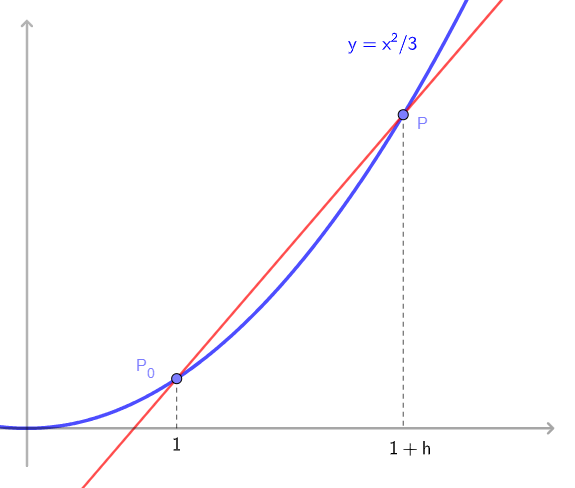
It is possible to understand how \(\varphi(h)\) behaves as \(h\) approaches zero. In fact, there exists a real number \(L\) such that \[\lim\limits_{h \to 0} \varphi(h) = L.\]
The line \(r\) passing through the point \(P_0\) and having this number \(L\) as its slope is called the tangent line to the graph of \(f\) at the point \(P_0\), and it is shown in purple in the animation below.
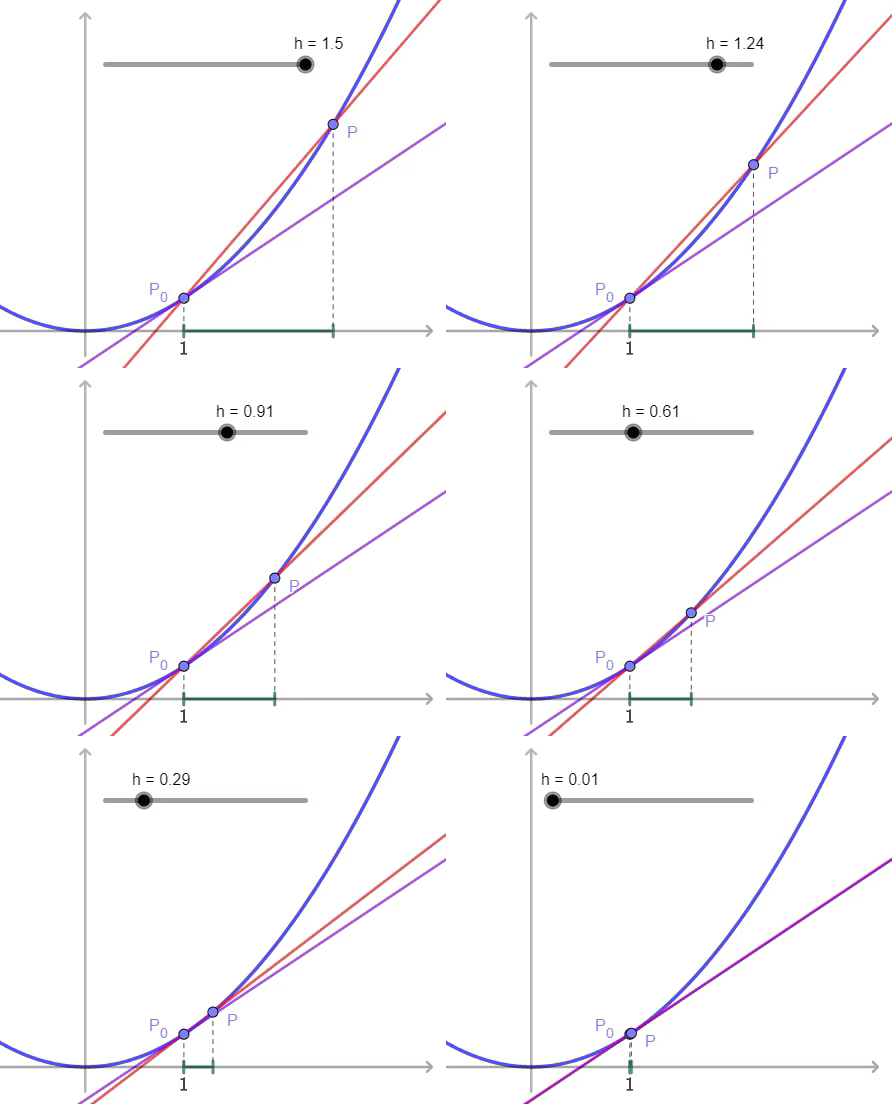
The Cartesian equation of the line \(r\) is given by:
(cod: P-44-14-15)
Let \(P\) be a point in the first quadrant on the curve \(y = x^n\), where n is a natural number greater than 1. Consider the segment \(\overline{OP}\) that connects the point \(P\) to the origin \(O\), and let \(M\) denote the midpoint of this segment. Consider the line \(r\) that is orthogonal to the segment \(\overline{OP}\) passing through \(M\), and let \(Q\) be the point given by the intersection of \(r\) with the \(y\)-axis. The figure below illustrates the situation in the case \(n = 2\):
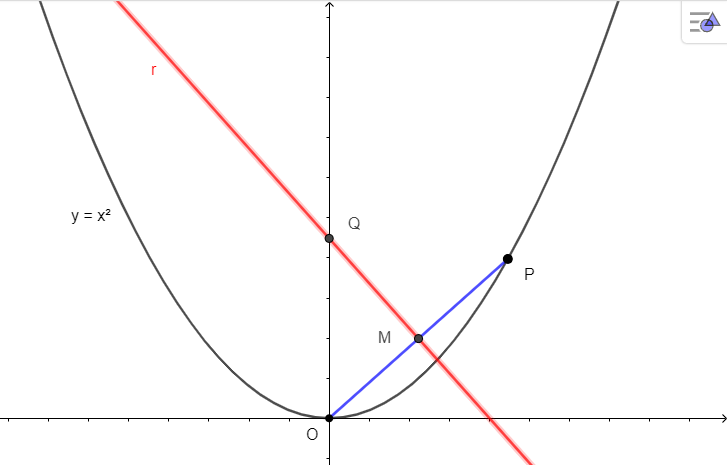
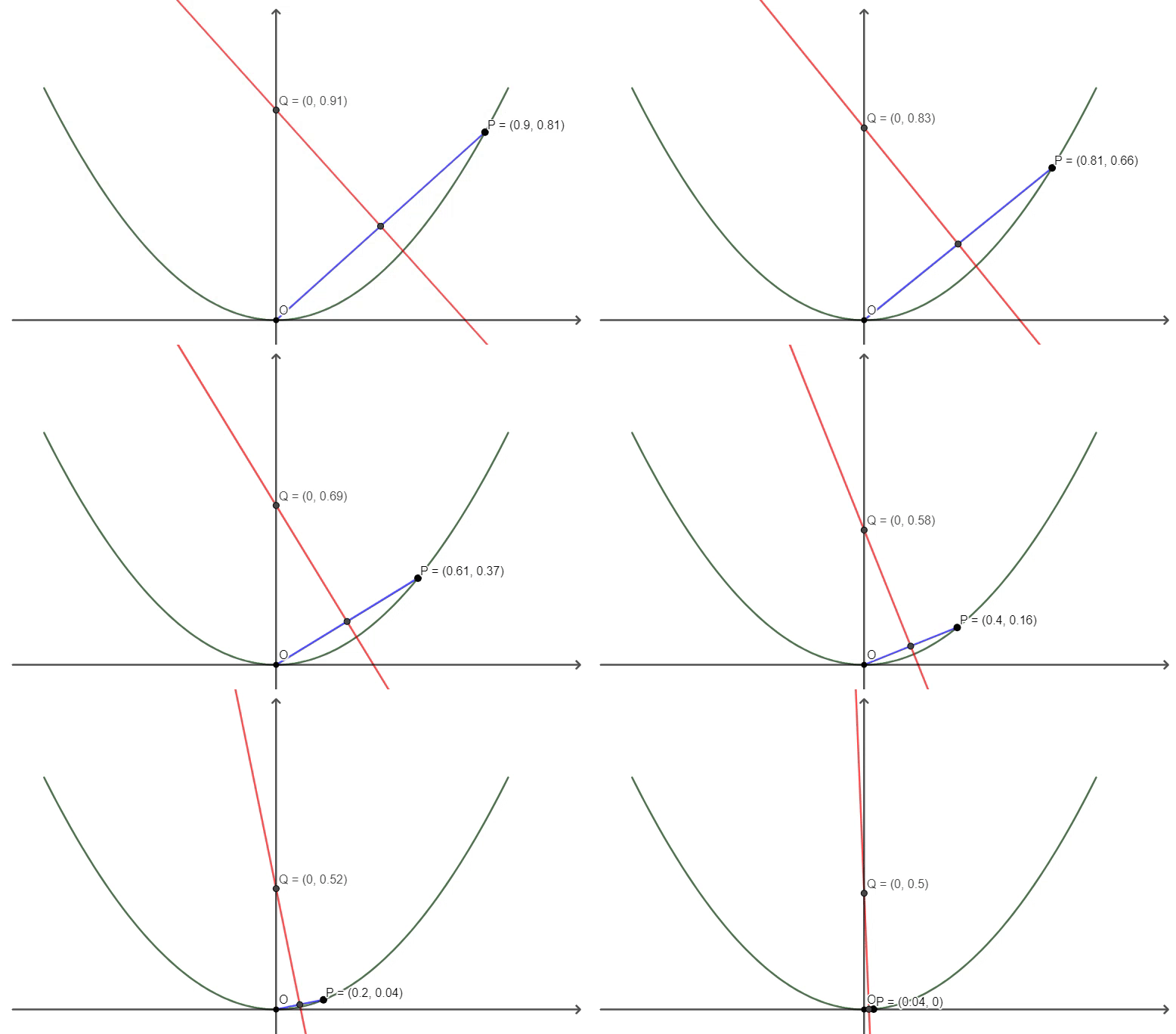
We want to determine what will happen to the point \(Q\) if we bring the point \(P\) closer to the origin, maintaining the described structure. Writing \(P = (t,t^n)\) and \(Q = (0,q(t))\), select the correct alternative:
(cod: P-44-13-12)
Let \(C_1\) be the circle with radius \(2\) centered at \((2, 0)\), and let \(C_2\) be the circle with radius \(r\) centered at the origin of the Cartesian plane, where \(0 < r < 4\). Consider point A = \((0,r)\) on \(C_2\) and point \(B\) in the first quadrant given by the intersection of \(C_1\) and \(C_2\). Let \(l\) be the line passing through \(A\) and \(B\), and denote by \(P\) the intersection of \(l\) with the \(x\)-axis. The figure below illustrates the situation: 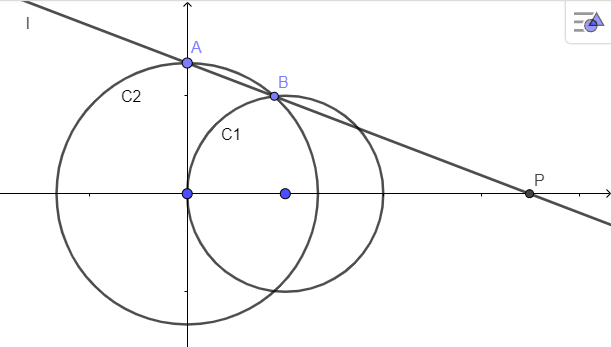
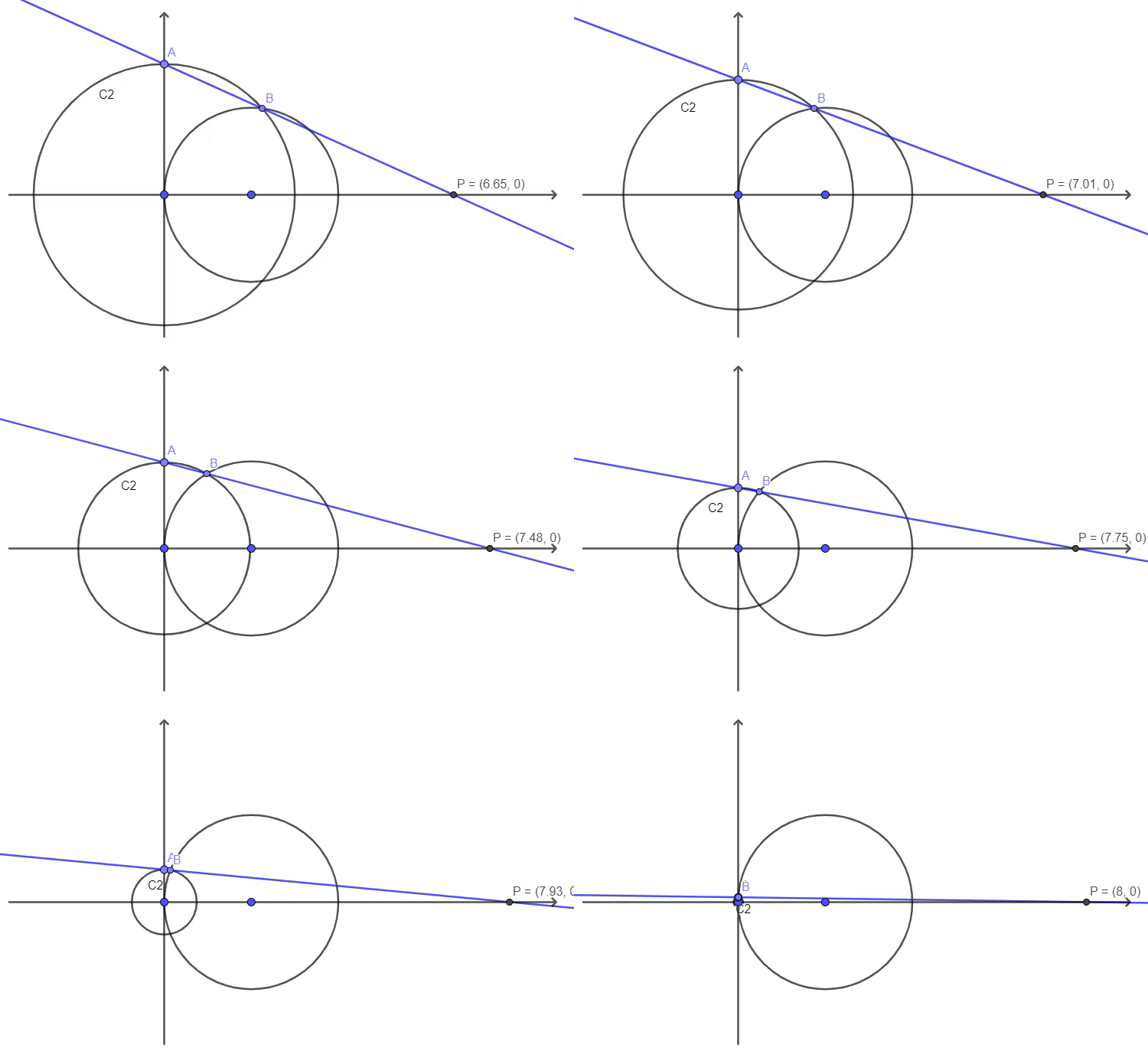
We are interested in understanding what happens to point \(P\) as \(r\) approaches zero, maintaining the structure described above. Writing \(P = (p(r),0)\), select the correct alternative:
(cod: P-48-36-7)
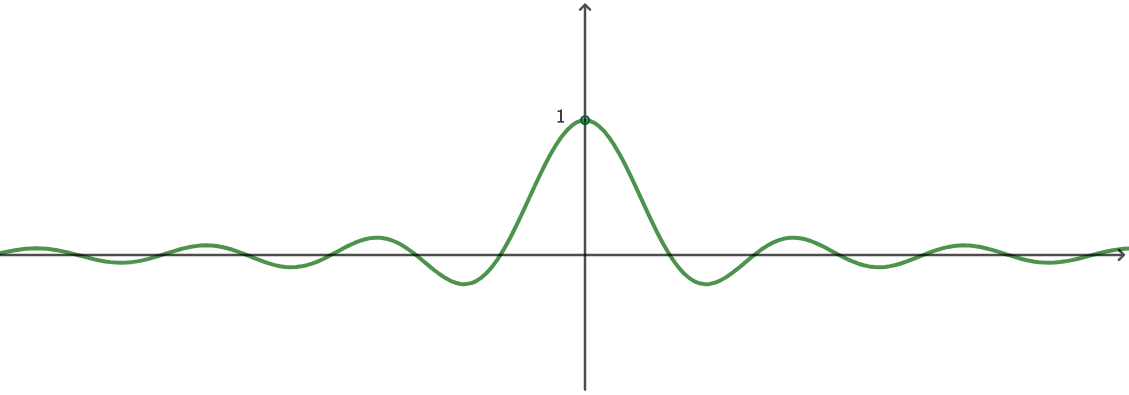
Consider the function \[f(x) = \dfrac{\sin(x)}{x}.\]
Select the correct alternative:
(cod: P-45-20-8)
Determine the values of the constants \(a\) and \(b\) so that the function below is continuous at \(x=0\):
\[f(x) = \begin{cases} \dfrac{\sin{(2x)}}{ax}, \text{ if } x<0, \\ \\
\dfrac{\sqrt{x^2+4} - \sqrt{x+4}}{2x}, \text{ if } x>0,\\ \\
b, \text{ if } x=0.
\end{cases}\]
(cod: P-43-17-7)
Let \(p(x) = a_n x^n + \cdots + a_1 x + a_0\), where \(n \in \mathbb{N}\), be a polynomial function with real coefficients. Select the correct alternative: