Derivatives
| Site: | DICA Project |
| Course: | Guest Area |
| Book: | Derivatives |
| Printed by: | Usuário visitante |
| Date: | Thursday, 24 September 2026, 7:14 AM |
(cod: P-49-43-6)
We say that a function \(f\) is differentiable or derivable at a number \(x_0\) in its domain if there exists
\begin{equation}\label{eq1} \lim\limits_{h \to 0} \dfrac{f(x_0 + h) - f(x_0)}{h}\end{equation}
and, in this case, the derivative of \(f\) at \(x_0\), denoted by \(f'(x_0)\), is given by the value of this limit, that is,
\[f'(x_0) = \lim\limits_{h \to 0} \dfrac{f(x_0 + h) - f(x_0)}{h}.\]
For a fixed value of \(h\), the ratio
\[\dfrac{f(x_0 + h) - f(x_0)}{h}, \]
appearing in the limit (\ref{eq1}) can be interpreted as the slope (inclination, or angular coefficient) of the secant line
passing through the points \(P = (x_0+h,f(x_0+h))\) and \(P_0 = (x_0,f(x_0))\). If \(f\) is differentiable
at \(x_0\), the line passing through \(P_0 = (x_0,f(x_0))\) with slope \(f'(x_0)\) is called the tangent line to the graph \(y = f(x)\) at \(P_0\).
In the animation below, the tangent line at \(P_0\) appears in lilac, in a case where \(x_0 = 1\).
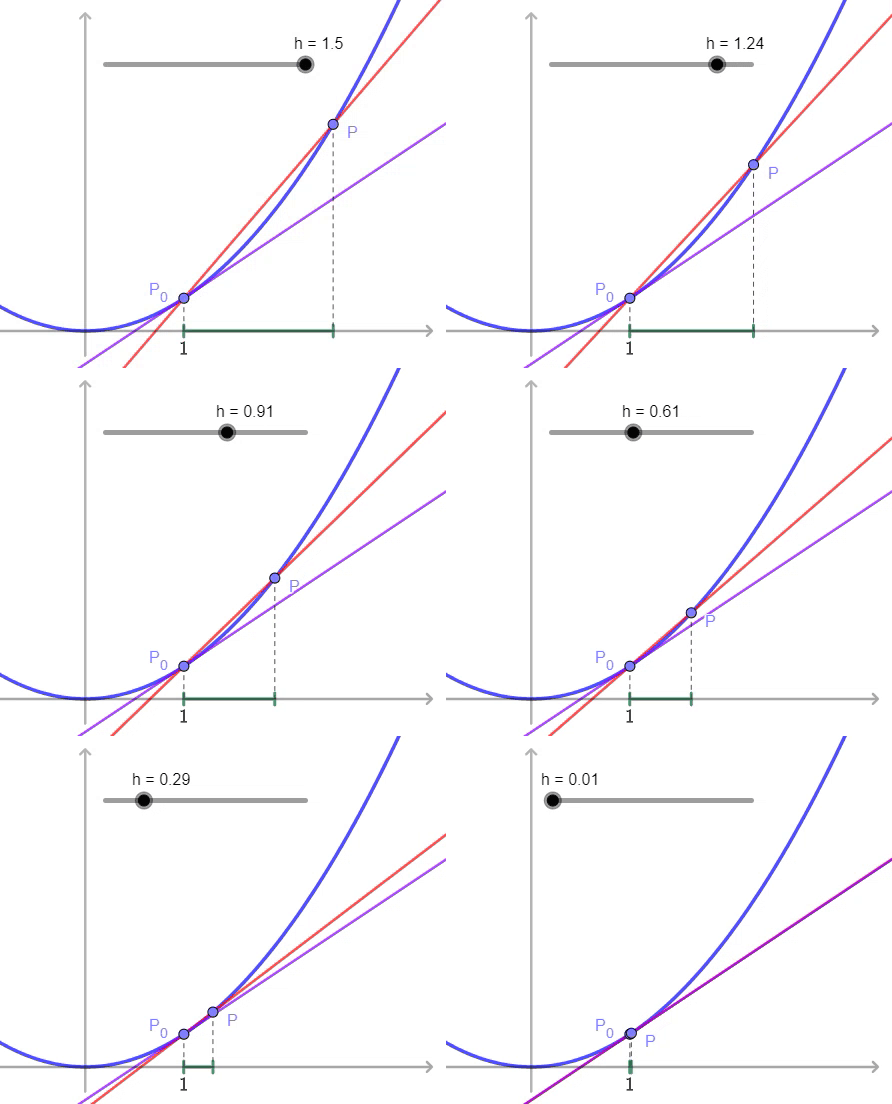
We observe that the limit in (\ref{eq1}) is equivalent to the limit
\begin{equation}\label{eq3} \lim\limits_{x \to x_0} \dfrac{f(x) - f(x_0)}{x - x_0},\end{equation}
that is, if one exists, then the other also exists and has the same value.
Given a function \(f: U \subset \mathbb{R} \to \mathbb{R}\), we can consider the derivative of \(f\) as the function
\[f'(x) = \lim\limits_{h \to 0} \dfrac{f(x+h) - f(x)}{h},\]
defined on the set
\[ \{x \in U: \ f \text{ is differentiable at } x\}.\]
Given a function \(y = f(x)\), we can use another way to denote its derivative, known as Leibniz notation (note that in this notation, we use \(\Delta x\) instead of \(h\)):
\[\dfrac{dy}{dx} = \lim \limits_{\Delta x \to 0} \dfrac{\overbrace{f(x+\Delta x) - f(x)}^{\Delta y}}{\Delta x}.\]
In fact, there are several ways to denote the derivative of a function \(y = f(x)\). We present some below:
\[f'(x) = \dfrac{dy}{dx} = \dfrac{d}{dx} \left(f(x)\right) = Df(x).\]
Leibniz notation emphasizes the derivative's nature as a rate of change. If \(y = f(x)\), note that
\[\dfrac{\Delta y}{\Delta x} = \dfrac{f(x+\Delta x) - f(x)}{\Delta x}\]
represents an average rate of change of \(y\) with respect to \(x\). The derivative arises when we let \(\Delta x\) approach zero.
Let us consider a more specific example. Suppose an object performs a rectilinear motion, so that its position can be described by
a function \(s = s(t)\) and represented graphically as a point on an axis. Note that
\[\dfrac{\Delta s}{\Delta t} = \dfrac{s(t+\Delta t) - s(t)}{\Delta t}\]
represents the average velocity over the time interval between the instants \(t\) and \(t + \Delta t\). In this case, the derivative of the position function represents
the instantaneous velocity of the object at the instant \(t\):
\[\small{v(t) = \dfrac{ds}{dt} = \lim\limits_{\Delta t \to 0} \dfrac{\Delta s}{\Delta t} = \lim\limits_{\Delta t \to 0}\dfrac{s(t+\Delta t) - s(t)}{\Delta t}.}\]
We have seen that, by differentiating a function, we obtain a new function, which is its derivative. We can then differentiate this new function, obtaining the second derivative or second derivative or derivative of second order. The second derivative of a function \(y = f(x)\) is denoted by
\[f''(x) \ \ \text{ or } \ \ \dfrac{d^2 y}{dx^2} \ \ \text{ or } \ \ f^{(2)}(x).\]
Proceeding inductively, if \(k\) is a natural number, we can consider the \(k\)-th derivative or derivative of order \(k\) of \(y = f(x)\), which we denote
by
\[f^{(k)}(x) \ \ \text{ or } \ \ \dfrac{d^k y }{dx^k}.\]
If \(s = s(t)\) describes the position of an object in rectilinear motion, then the second derivative \(s''(t)\) represents the instantaneous acceleration of the object at the instant \(t\).
Consider the following questions:
(1) If \(f\) is a differentiable function at a number \(x_0\) in its domain, then is \(f\) necessarily continuous at \(x_0\)? Conversely, if
a function \(f\) is continuous at a number \(x_0\) in its domain, then is \(f\) necessarily differentiable at \(x_0\)?
(2) If \(n\) is a natural number, determine the tangent line to the graph of the function \(f(x) = x^n\) at the point \(P_0 = (1,1)\).
(3) A projectile is launched vertically upwards. Its height, in feet, after \(t\) seconds, is given by
\(s = s(t) = 144t - 16t^2, \ t \in [0,9]\). Determine the velocity \(v(t)\) of the projectile (in feet per second) and the acceleration \(a(t)\) of the projectile (in feet per second squared).
Select the correct alternative:
(cod: P-49-28-5)
Below are statements involving the derivative of various functions:
(1) If \(c \in \mathbb{R}\), \(\dfrac{d}{dx}\left(c\right) = 0.\)
(2) If \(c \in \mathbb{R}\), \(\dfrac{d}{dx}\left(cx\right) = cx\)
(3) If \(n \in \mathbb{N}\), \(\dfrac{d}{dx}\left(x^n \right) = nx^{n-1}\)
(4) \(\dfrac{d}{dx}\left(x^{1/2}\right) = \frac{1}{2} x^{1/2 - 1} = \dfrac{1}{2\sqrt{x}}\)
(5) If \(n \in \mathbb{N}\), \(\dfrac{d}{dx}\left(x^{-n} \right) = nx^{-n-1}\)
(6) \(\dfrac{d}{dx}\left(\sin(x) \right)= \cos(x) \)
(7) \(\dfrac{d}{dx}\left(\cos(x)\right)= \sin(x)\)
(8) \(\dfrac{d}{dx}\left(\tan(x)\right) = \sec^2(x)\)
(9) \(\dfrac{d}{dx}\left(\sec(x)\right) = \tan^2(x)\)
(10) \(\dfrac{d}{dx}\left(b^x \right) = b^x \ln(b)\)
(11) If \(0 < b \ne 1\), \(\dfrac{d}{dx}\left(\log_b(x)\right) = \dfrac{1}{x}\)
(12) \(\dfrac{d}{dx}\left(e^x\right) = e^x\)
(13) \(\dfrac{d}{dx}\left(\ln(x)\right) = \dfrac{1}{x}\)
(14) \(\dfrac{d}{dx}\left(3^x\right) = x 3^{x-1}\)
We can state that:
(cod: P-52-29-11)
Consider the following questions:
(1) \(\dfrac{d}{dx}\left(\dfrac{2x^2}{x^2 - 9}\right)\) is equal to:
(2) \(\dfrac{d}{dx}\left(e^{-2x}\cos(3x)\right)\) is equal to:
(3) Let \(F\), \(G\), and \(H\) be differentiable functions such that:
\begin{eqnarray*}
F(0) &=& 2, \ \ \ \ \ \ \ F'(0) &=& 3,
\\ G(0) &=& 1, \ \ \ \ \ \ \ G'(0) &=& -1,
\\ G(1) &=& -1, \ \ G'(1) &=& 1,
\\ H(0) &=& 1, \ \ \ \ \ \ \ H'(0) &=& 2.
\end{eqnarray*}
If \(f(x) = F(x)G(H(x))\), determine \(f'(0)\).
(4) Let \(f : I \to J\) be a differentiable bijection between open intervals \(I\) and \(J\) such that
\[f(1) = 0 \ \ \ \text{and} \ \ \ f'(1) = \dfrac{1}{2}.\] Denote by
\(f^{-1}:J \to I\) the inverse of \(f\) and consider the function \(g(t) = (t^2 + t + 3)f^{-1}(t)\). Determine the value of \(g'(0)\).
Select the alternative that correctly answers the four questions above.
(cod: P-52-32-5)
Consider the following statements:
(1) If \(f(x) = x^r\), for \(x > 0\), where \(r\) is any real number, then \(f'(x) = r x^{r-1}\).
(2) \(\dfrac{d}{dx}\ln(|x|) = \dfrac{1}{x}.\)
(3) \(\dfrac{d}{dx} \sinh\, x = \cosh{x}.\)
(4) \(\dfrac{d}{dx} \cosh{x} = - \sinh\, {x}.\)
(5) \(\dfrac{d}{dx} \tanh{x} = \operatorname{sech}^2\, {x}.\)
(6) \(\dfrac{d}{dx} \operatorname{sech}\, {x} = \operatorname{sech}\, {x} \tanh{x}.\)
Regarding these statements, we have that:
(cod: P-53-35-12)
Consider the curve \(\mathcal{C}\) given by the equation \[x^2 + 2xy + 3y^2 = 8.\] We take a circle \(C_r\) with radius \(r>0\) centered at the origin such that it contains the curve \(\mathcal{C}\) within its interior. Then, we gradually decrease \(r\) until the circle touches the curve \(\mathcal{C}\) at two points \(P_1\) and \(P_2\), as shown in the animation below.
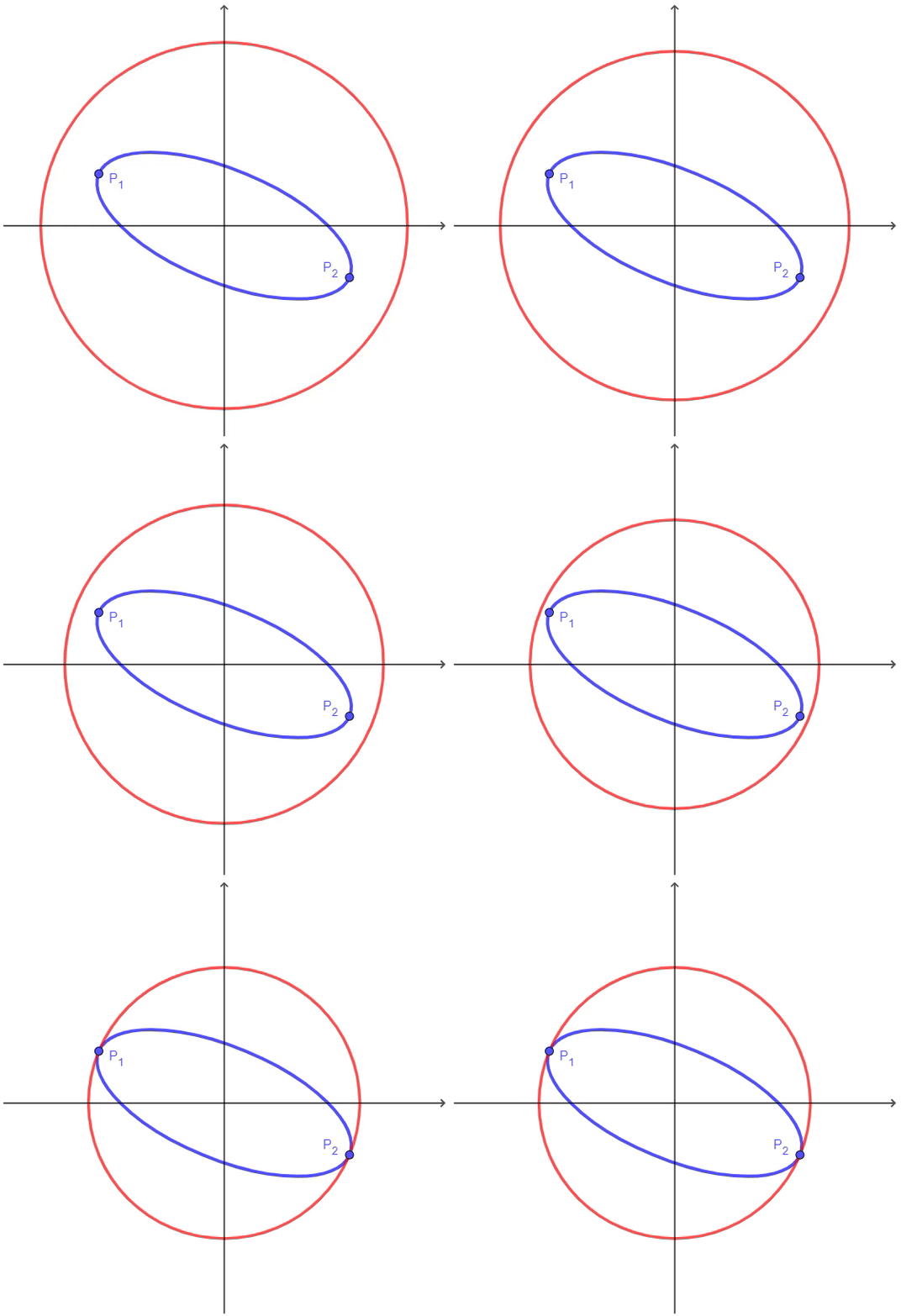
At points \(P_1\) and \(P_2\), the circle and the curve \(\mathcal{C}\) are tangent, meaning that at each of these points, the curve \(\mathcal{C}\) and the circle touching it share the same tangent line. Observe that \(P_1\) and \(P_2\) are the points on the curve \(\mathcal{C}\) farthest from the origin. Let \(D_M\) denote the distance of these points from the origin.
Now, we take a circle with radius \(r>0\) centered at the origin and contained within the region bounded by the curve \(\mathcal{C}\). Then, we gradually increase \(r\) until the circle touches the curve \(\mathcal{C}\) at points \(P_3\) and \(P_4\), as shown in the animation below.
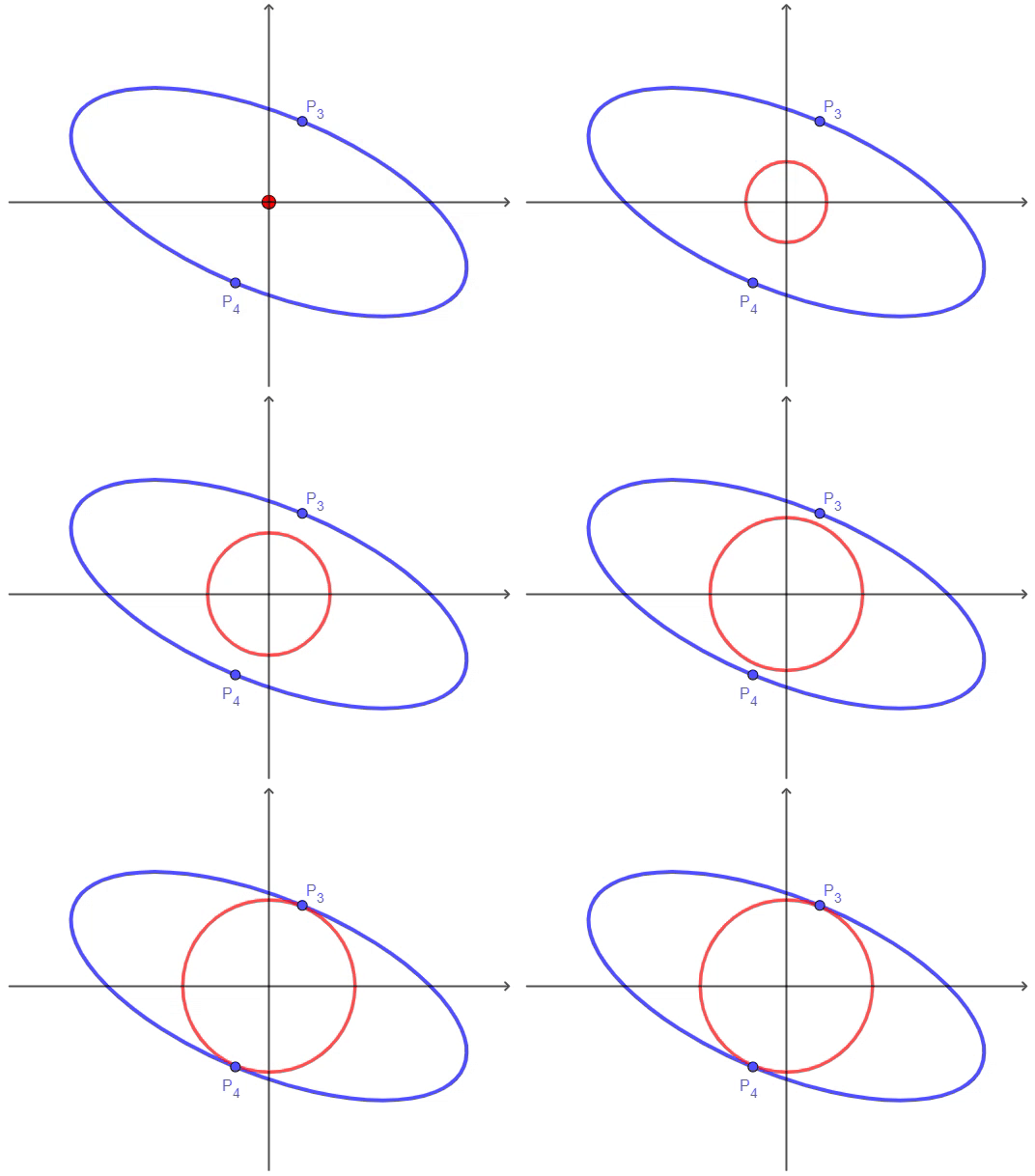
At points \(P_3\) and \(P_4\), the circle and the curve are tangent. Note that \(P_3\) and \(P_4\) are the points on the curve \(\mathcal{C}\) closest to the origin. Let \(D_m\) denote the distance of these points from the origin.
Using implicit differentiation and the observations above, we can verify that the values of \(D_M\) and \(D_m\) are, respectively:
(cod: P-80-8-10)
Let \(a_1, a_2, \dots, a_n\) be positive numbers and consider the function
\[f(t) = \left\{\begin{array}{ll} \left(\dfrac{a_1^t + \cdots + a_n^t}{n}\right)^{\frac{1}{t}}, & \text{ if } t \ne 0 \\
A, & \text{ if } t=0.\end{array} \right. \]
Observe that, for each fixed \(t \ne 0\), \(f(t)\) represents a type of mean of the numbers \(a_1, \dots, a_n\). For example, \(f(1)\) is the arithmetic mean of these numbers, while \(f(-1)\) is the harmonic mean of the same numbers.
Determine the value of the constant \(A\) so that the function \(f\) is continuous at \(t=0\).