Graphs of Functions and Optimization Problems
| Site: | DICA Project |
| Course: | Guest Area |
| Book: | Graphs of Functions and Optimization Problems |
| Printed by: | Usuário visitante |
| Date: | Thursday, 24 September 2026, 7:10 AM |
(cod: P-64-24-11)
Consider the following statements:
(1) If \(f\) is a differentiable function on an open interval \(I\), with \(f'(x) > 0\) for all \(x \in I\), then \(f\) is increasing on \(I\).
(2) If \(x_0\) is a critical point of \(f\), then \(f\) has a local maximum or a local minimum at \(x_0\).
(3) Let \(f:I \subset \mathbb{R}\) be a continuous function on an open interval \(I\). Suppose there exists an interval \((a,b)\) such that \(x_0 \in (a,b) \subset I\) with \(f'(x)<0\) for all \( x \in (a,x_0)\) and \(f'(x)<0\) for all \(x \in (x_0,b)\). In this case, we can state that \(x_0\) is a local maximum point.
(4) If \(f\) is a twice-differentiable function such that \(f''(x) >0\) for all \(x\) in an open interval \(I\), then \(f'\) is increasing on \(I\). That is, \(f\) is concave up on \(I\), so its graph lies below all its tangents on \(I\).
(5) If \(f''(x_0) = 0\), then \((x_0,f(x_0))\) is an inflection point of the graph of \(f\).
(6) Suppose \(f'(x_0) = 0\) and that \(f\) is twice differentiable at \(x_0\). If \(f''(x_0) > 0\), then \(f\) has a local maximum at \(x_0\).
Regarding these statements, we have that:
(cod: P-64-10-18)
Consider the function \(f(x) = \dfrac{2x^2}{x^2-1}\). Select the figure that best represents the graph of \(f\):
(cod: P-61-26-6)
Consider the following statements:
(1) A continuous function \(f:[a,b] \to \mathbb{R}\) on a closed and bounded interval \([a,b]\) must attain an absolute minimum value.
(2) If a continuous function has a local extremum at a number \(x_0\) in its domain, then \(f\) must be differentiable at \(x_0\) and \(f'(x_0)=0\).
(3) If a continuous function has a critical point at a point \(x_0\) in the interior of its domain, then \(f\) has a local extremum at \(x_0\).
(4) If \(f:[a,b] \to \mathbb{R}\) is a continuous function on the compact interval (closed and bounded) \([a,b]\), then \(f\) attains an absolute maximum value. Furthermore, this value is either attained at an endpoint of the interval or at a critical point of \(f\) in \((a,b)\).
(5) Let \(f:I \to \mathbb{R}\) be a continuous function on an open interval \(I\) that has a critical point at \(x_0 \in I\). If \(f'(x)>0\) for all \(x < x_0\) in \(I\) and \(f'(x)<0\) for all \(x > x_0\) in \(I\), then \(f\) attains an absolute maximum at \(x_0\).
Among the statements above, we can assert that:
(cod: P-61-9-12)
The goal is to construct a can in the shape of a right circular cylinder with a volume of 1 liter. Determine the smallest possible value for the total surface area of this can (including the lid, base, and lateral surface).
(cod: P-61-45-6)
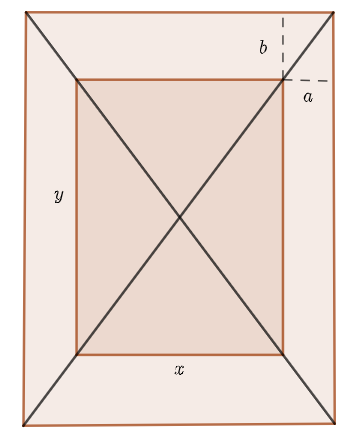
A company manufactures picture frames with rectangular borders, where the left/right widths measure \(a = 4 \, cm\) and the top/bottom widths measure \(b = 6 \, cm\), as illustrated in the figure. The company fixes the main area of the picture frame (to be occupied by the picture) at \(384 \, cm^2\).
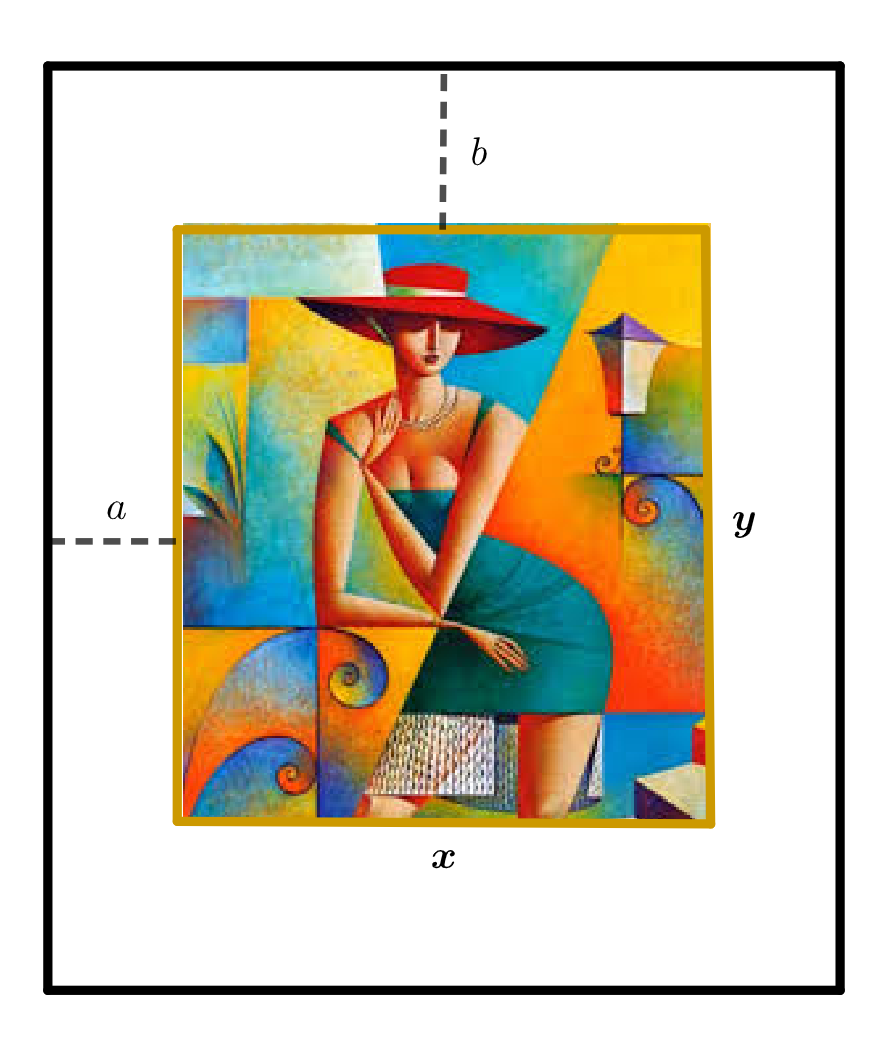
Determine the smallest possible value for the area of the front part of the borders.
(cod: P-61-46-6)
A conical-shaped cup is to be constructed as follows: from a circular sheet with radius \(R = 9 \, cm\), a circular sector \(OAB\) with central angle \(\theta\) is cut out. The remaining part of the sheet is converted into a cone by aligning \(OA\) with \(OB\), as shown in the figure below.
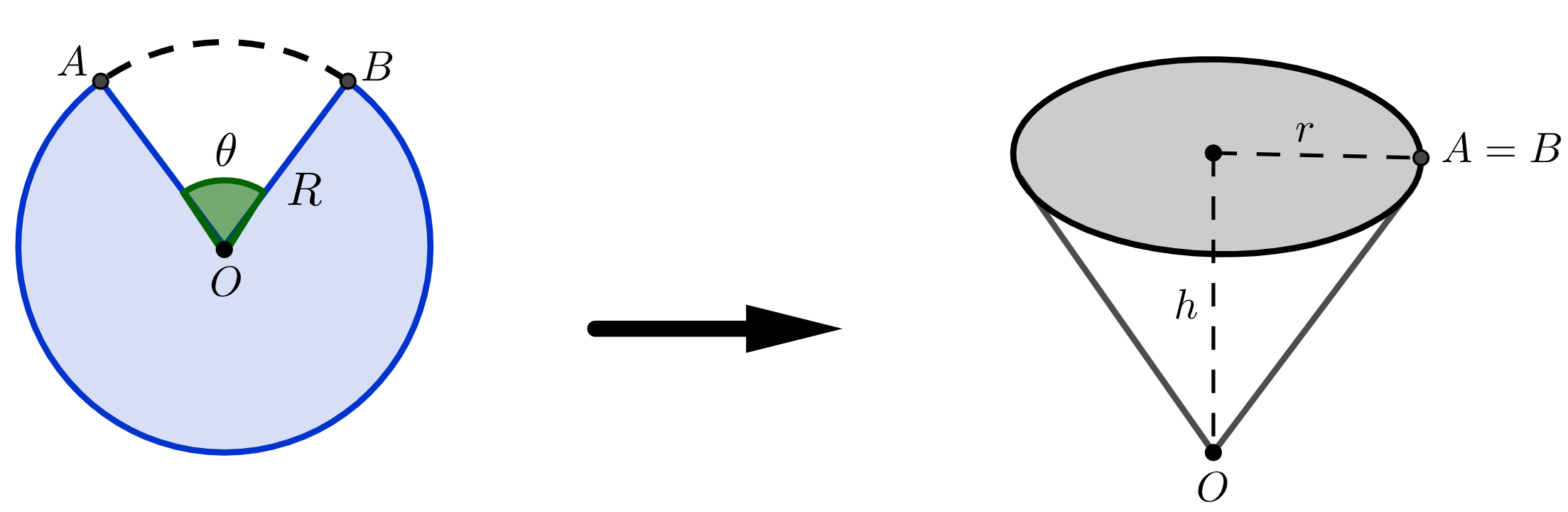
Determine the value of \(\theta\) in radians that maximizes the volume of the cup.