Integrals and the Fundamental Theorem of Calculus
(cod: P-67-37-4)
The objective of this exercise is to obtain the area of the region \(\mathcal{R}\) bounded by the parabola \(y = x^2\) and the lines \(y = 0\) (axis \(x\)) and \(x=1\), using an exhaustion method. 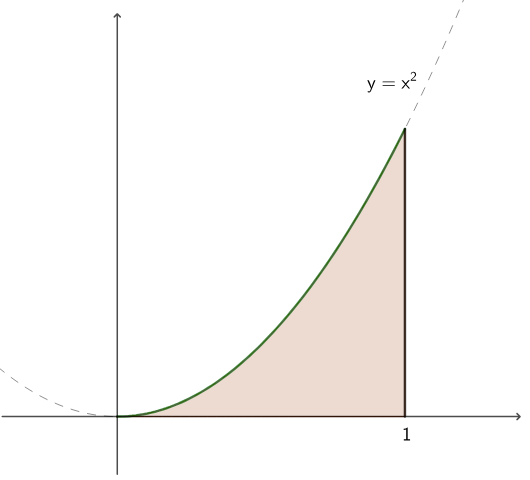
Fixing a natural number \(n\), we divide the interval \([0,1]\) on the \(x\) axis into \(n\) equal subintervals and then draw vertical segments to divide the region \(\mathcal{R}\) into \(n\) strips. The figure below illustrates the situation for \(n = 5\). 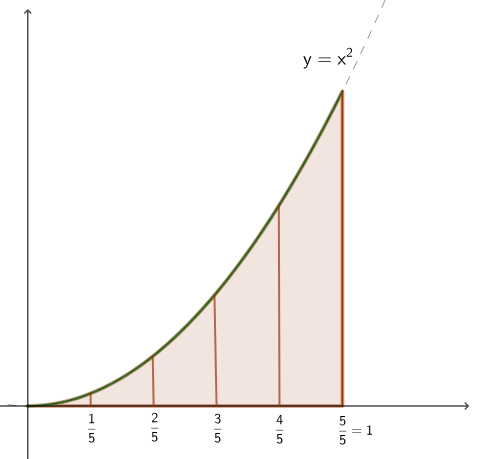
First, we approximate the area of each of the \(n\) strips by the area of a rectangle, whose base lies on the \(x\) axis (measuring \(1/n\)) and whose height is given by the vertical segment coinciding with the right side of the respective strip. The figure below illustrates the situation when \(n = 5\). 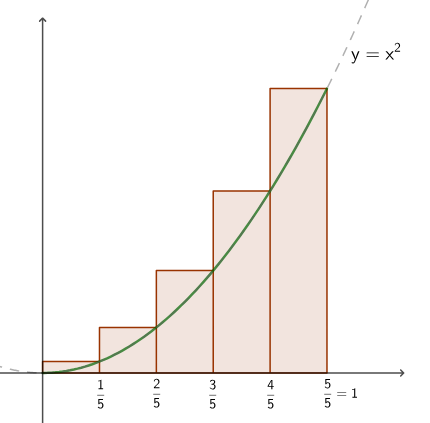
We can then approximate the area of \(\mathcal{R}\) by the sum of the areas of the \(n\) rectangles, which we denote by \(S_n\). We have \[\small{\begin{eqnarray*} S_n &=& \frac{1}{n}\left(\frac{1}{n}\right)^2 + \frac{1}{n}\left(\frac{2}{n}\right)^2 + \cdots + \frac{1}{n}\left(\frac{n}{n}\right)^2
\\ & & \\ &=& \dfrac{1}{n^3}\left(1^2 + 2^2 + \cdots + n^2 \right).
\end{eqnarray*}}
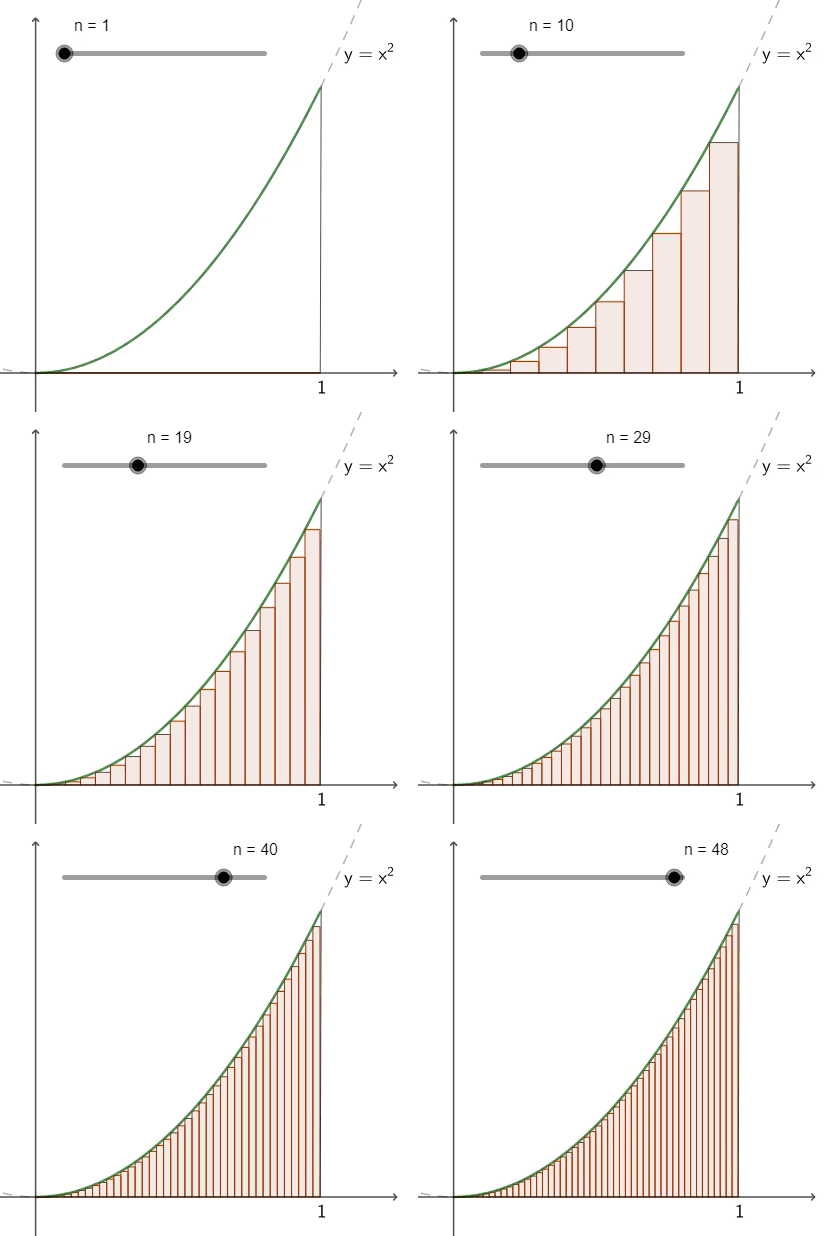
\] Another possibility would be to approximate the area of each strip by the area of a rectangle with base \(\frac{1}{n}\) and height given by the vertical segment coinciding with the left side of the strip (note that the first rectangle will have zero height, so its area will also be zero). The figure shows the situation when \(n = 5\): 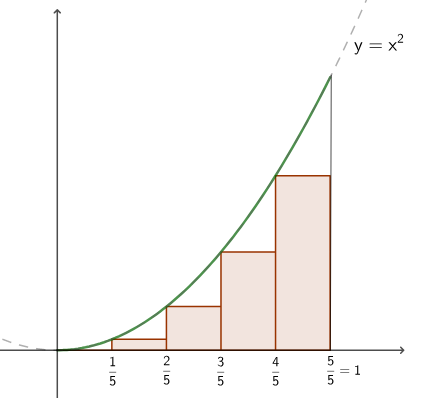
We can then approximate the area of \(\mathcal{R}\) by the sum of the areas of the \(n\) rectangles, which we denote by \(s_n\). We have \[\small{\begin{eqnarray*} s_n &=& \frac{1}{n}\left(\frac{0}{n}\right)^2 + \frac{1}{n}\left(\frac{1}{n}\right)^2 + \cdots + \frac{1}{n}\left(\frac{n-1}{n}\right)^2
\\ & & \\ &=& \dfrac{1}{n^3}\left(1^2 + 2^2 + \cdots + (n-1)^2 \right).
\end{eqnarray*}}
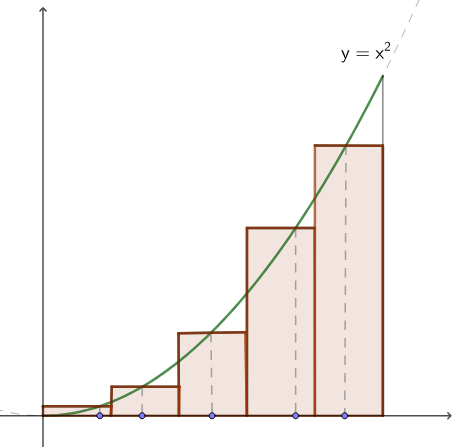
\] It is possible to verify that the approximations \(A(\mathcal{R}) \approx S_n\) and \(A(\mathcal{R}) \approx s_n\) improve as we increase the value of \(n\), as suggested by the animations below: 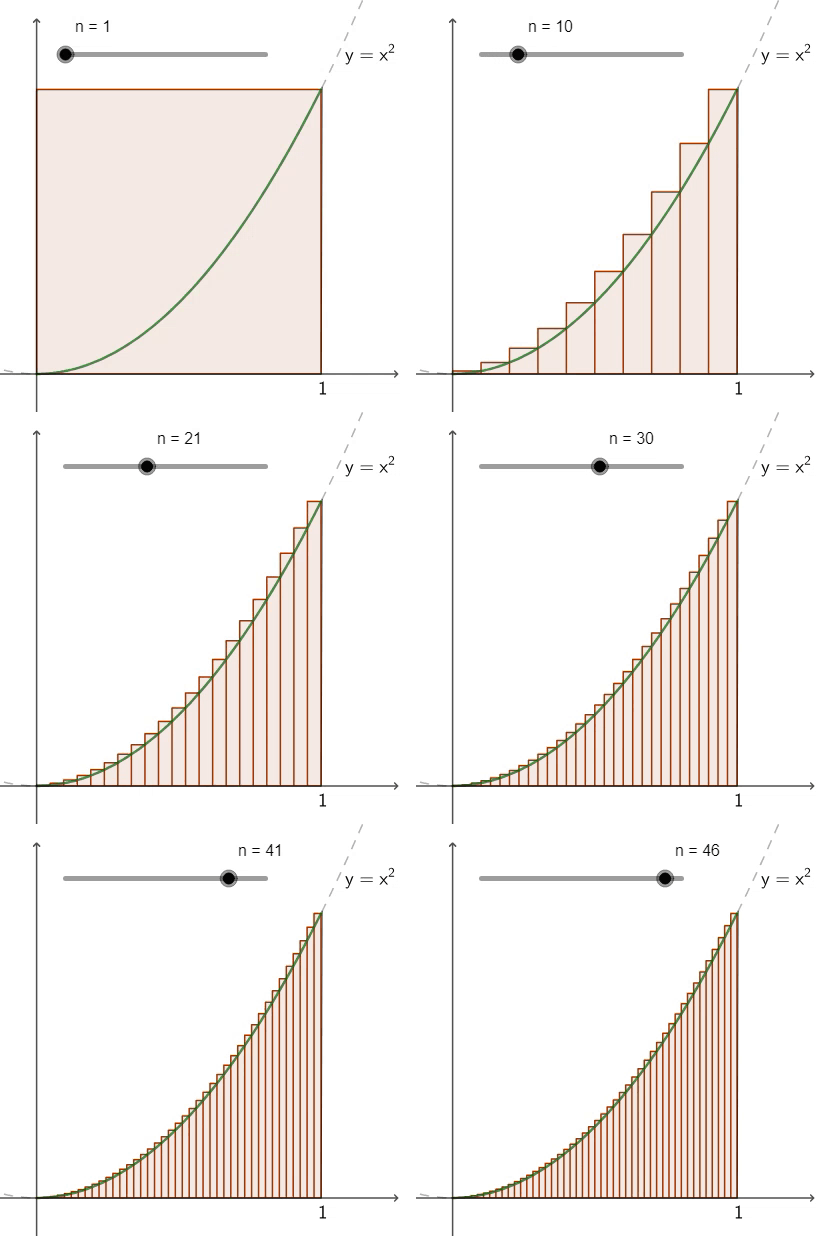
First, note that for each \(n \in \mathbb{N}\), we have \[s_n \leq A(\mathcal{R}) \leq S_n.\] Now, using the expressions for \(s_n\) and \(S_n\) described above, verify that \(s_n\) and \(S_n\) tend to the same real number as \(n\) tends to infinity. We then define \(A(\mathcal{R})\) as being equal to this number. Select the correct option: