Integrals and the Fundamental Theorem of Calculus
(cod: P-67-43-8)
Consider an object moving with a scalar velocity \(V(t)\) (in meters per second). Recall that scalar velocity is the magnitude of the velocity vector, and therefore, it is always non-negative.
If the scalar velocity is constant over a time interval \([a,b]\), that is, if \(V(t) = V_0\), for all \(t \in [a,b]\), then the distance traveled by the object during the time interval \([a,b]\) is equal to \(V_0 (b-a)\).
Now, consider the case where the scalar velocity is not constant. Divide the interval \([a,b]\) into \(n\) subintervals of equal length \(\Delta t = \dfrac{b-a}{n}\). If we choose \(n\) large, these subintervals become very small, allowing us to assume that the velocity varies little within each subinterval. As an approximation, consider that the velocity in the \(i\)-th subinterval is constant and equal to \(V(t_i^*)\), where \(t_i^*\) is a sample point within this subinterval. We can then approximate the distance traveled in the \(i\)-th subinterval by \(V(t_i^*)\Delta t\). The distance traveled during the time interval \([a,b]\) can then be approximated by \[L \approx \sum_{i = 1}^n V(t_i^*) \Delta t.\]
The exact value of the distance traveled during the time interval \([a,b]\) is then given by \[L = \lim\limits_{n \to + \infty} \sum_{i = 1}^n V(t_i^*) \Delta t = \int_a^b V(t) \, dt.\]
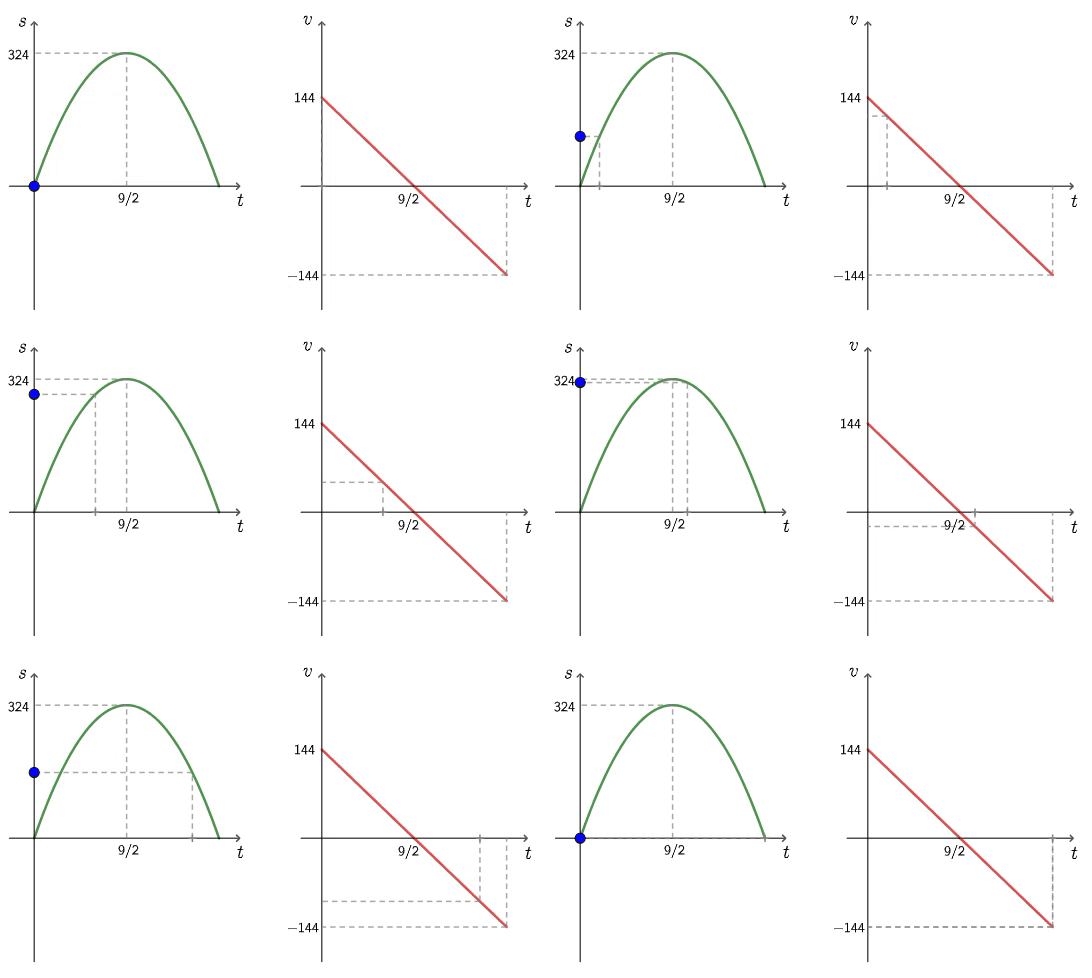
Now consider an object launched vertically (in rectilinear motion), whose height (position), in feet, after \(t\) seconds is given by \[s = s(t) = 144t - 16t^2, \, \, t \in [0,9].\] The velocity of the object is given by \(v(t) = \dfrac{ds}{dt}\). Note that, since the motion is rectilinear, the velocity always points in the same direction (the direction of the motion axis), but not necessarily in the same sense. The scalar velocity is given by \(V(t) = |v(t)|\).
Consider the following questions:
(1) Determine the distance traveled \[L = \int_0^9 V(t) \, dt.\]
(2) Determine the value of the integral \[\int_a^b v(t) \, dt.\]