Derivatives
(cod: P-53-35-12)
Consider the curve \(\mathcal{C}\) given by the equation \[x^2 + 2xy + 3y^2 = 8.\] We take a circle \(C_r\) with radius \(r>0\) centered at the origin such that it contains the curve \(\mathcal{C}\) within its interior. Then, we gradually decrease \(r\) until the circle touches the curve \(\mathcal{C}\) at two points \(P_1\) and \(P_2\), as shown in the animation below.
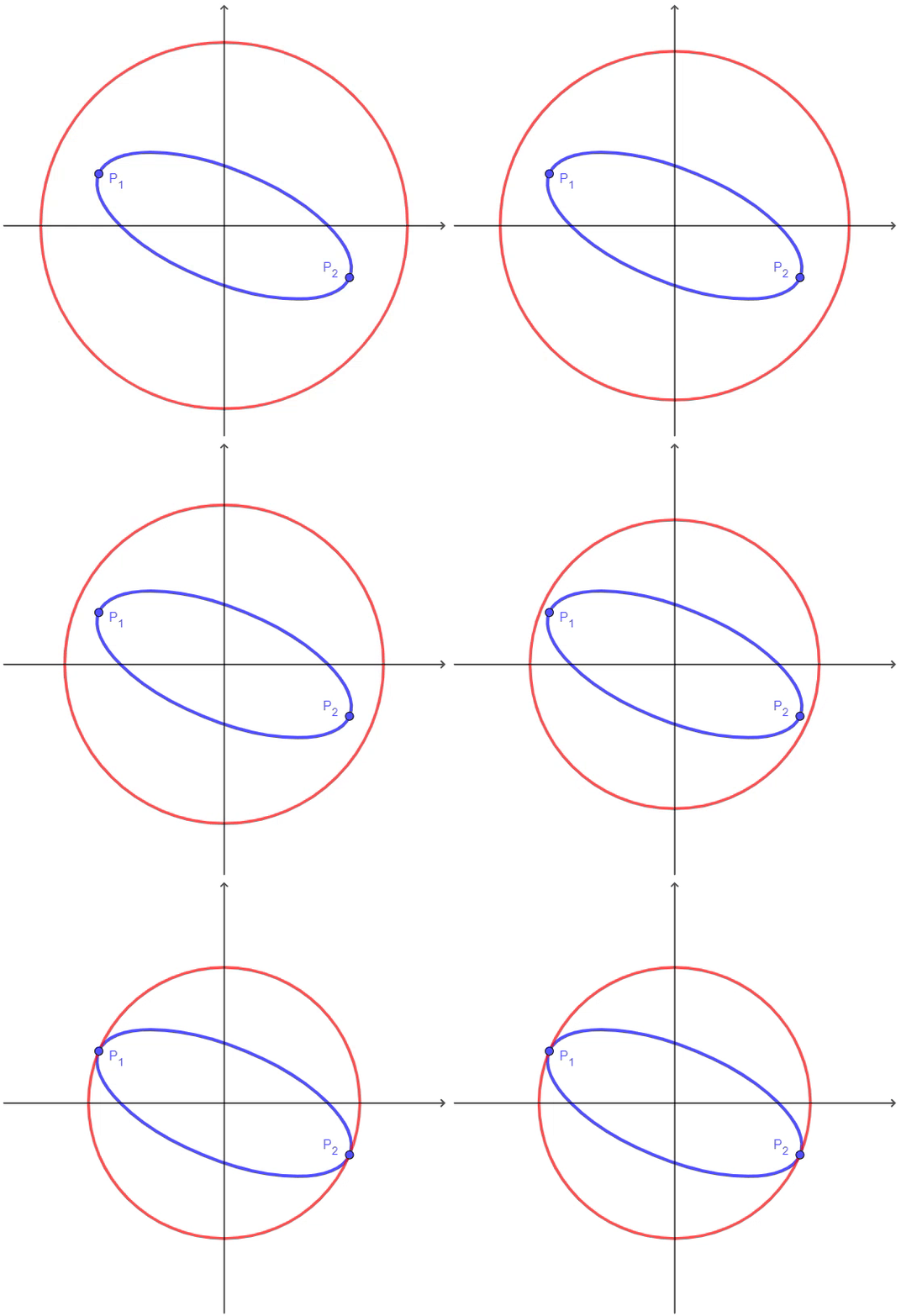
At points \(P_1\) and \(P_2\), the circle and the curve \(\mathcal{C}\) are tangent, meaning that at each of these points, the curve \(\mathcal{C}\) and the circle touching it share the same tangent line. Observe that \(P_1\) and \(P_2\) are the points on the curve \(\mathcal{C}\) farthest from the origin. Let \(D_M\) denote the distance of these points from the origin.
Now, we take a circle with radius \(r>0\) centered at the origin and contained within the region bounded by the curve \(\mathcal{C}\). Then, we gradually increase \(r\) until the circle touches the curve \(\mathcal{C}\) at points \(P_3\) and \(P_4\), as shown in the animation below.
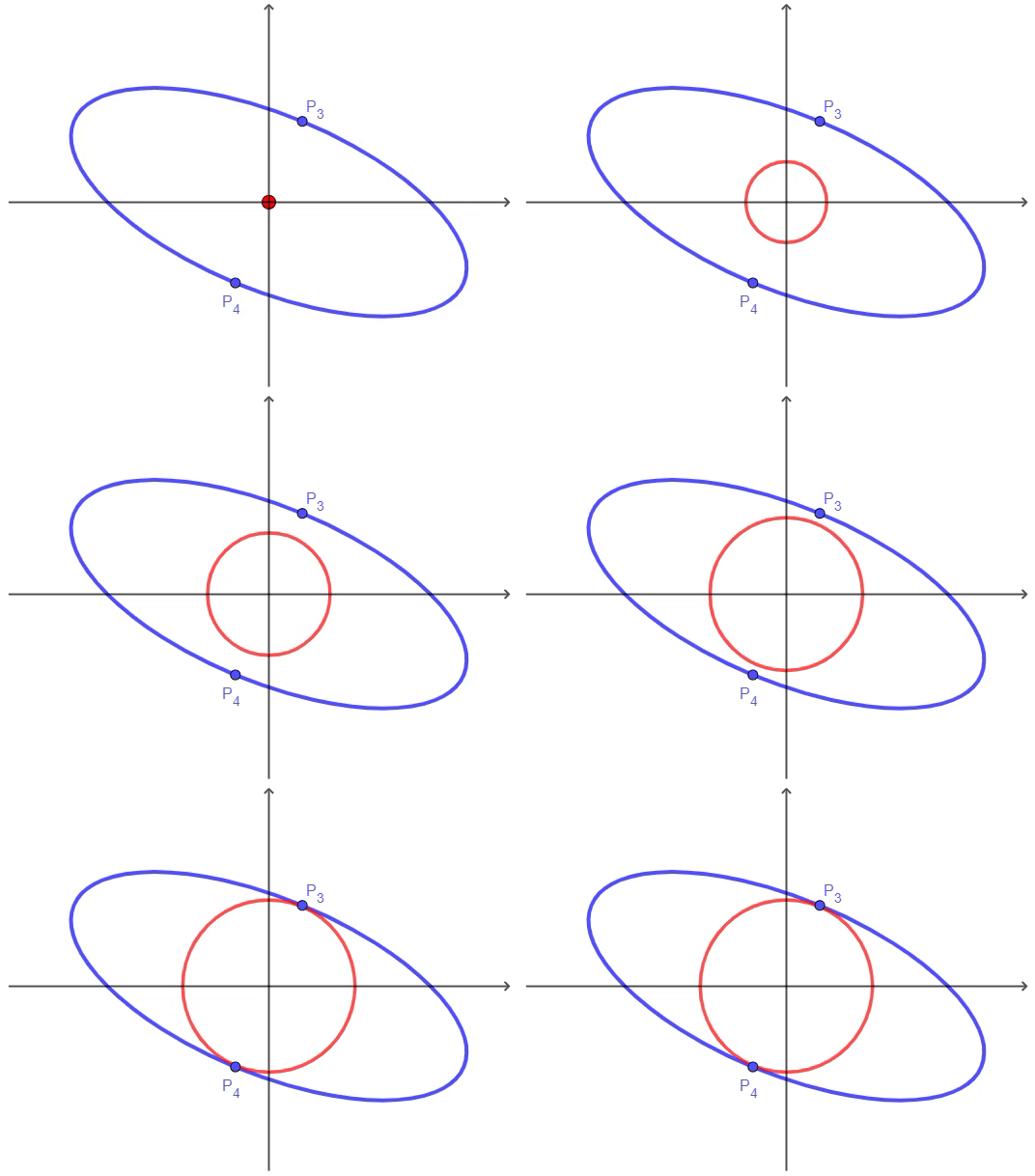
At points \(P_3\) and \(P_4\), the circle and the curve are tangent. Note that \(P_3\) and \(P_4\) are the points on the curve \(\mathcal{C}\) closest to the origin. Let \(D_m\) denote the distance of these points from the origin.
Using implicit differentiation and the observations above, we can verify that the values of \(D_M\) and \(D_m\) are, respectively: