Limits and Continuity
Completion requirements
(cod: P-44-13-12)
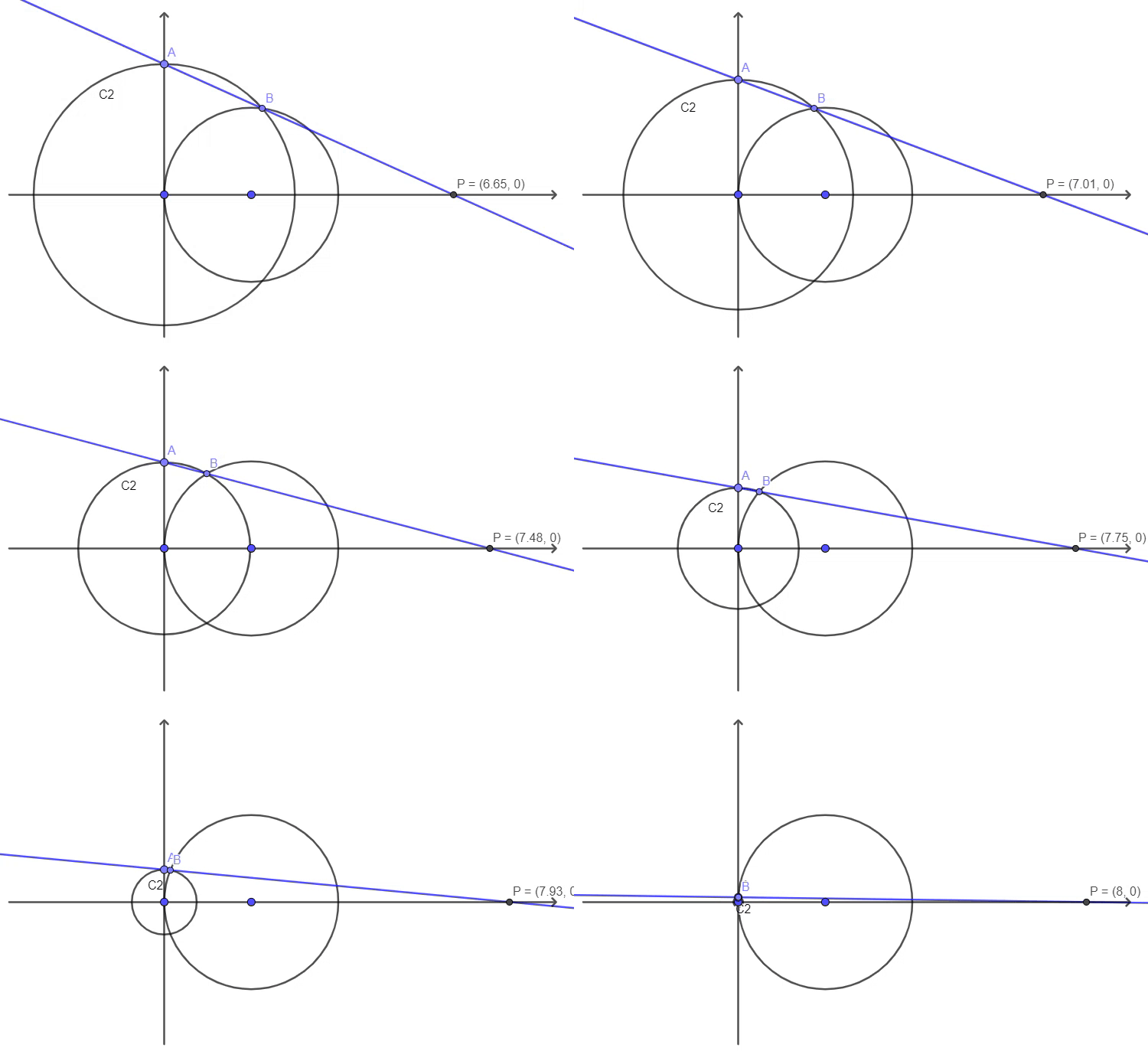
Let \(C_1\) be the circle with radius \(2\) centered at \((2, 0)\), and let \(C_2\) be the circle with radius \(r\) centered at the origin of the Cartesian plane, where \(0 < r < 4\). Consider point A = \((0,r)\) on \(C_2\) and point \(B\) in the first quadrant given by the intersection of \(C_1\) and \(C_2\). Let \(l\) be the line passing through \(A\) and \(B\), and denote by \(P\) the intersection of \(l\) with the \(x\)-axis. The figure below illustrates the situation: 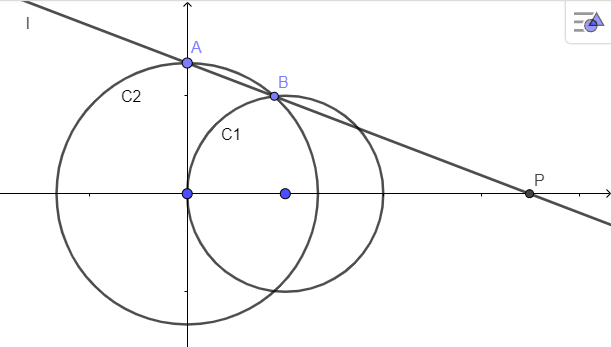
We are interested in understanding what happens to point \(P\) as \(r\) approaches zero, maintaining the structure described above. Writing \(P = (p(r),0)\), select the correct alternative: