Limits and Continuity
(cod: P-44-15-9)
Consider the function \(f(x) = x^2/3\) and let \(P_0\) be the point on the graph of \(f\) whose first coordinate is equal to \(1\). Given \(h \ne 0\), consider the point \(P\) on the graph of \(f\) whose first coordinate is equal to \(1 + h\), and denote by \(\varphi(h)\) the slope of the line passing through the points \(P_0\) and \(P\).
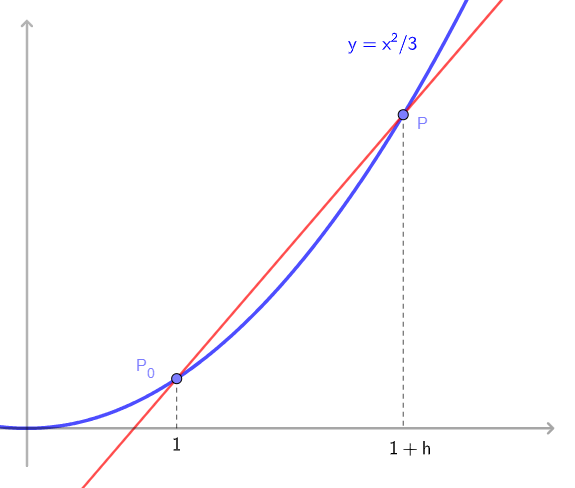
It is possible to understand how \(\varphi(h)\) behaves as \(h\) approaches zero. In fact, there exists a real number \(L\) such that \[\lim\limits_{h \to 0} \varphi(h) = L.\]
The line \(r\) passing through the point \(P_0\) and having this number \(L\) as its slope is called the tangent line to the graph of \(f\) at the point \(P_0\), and it is shown in purple in the animation below.
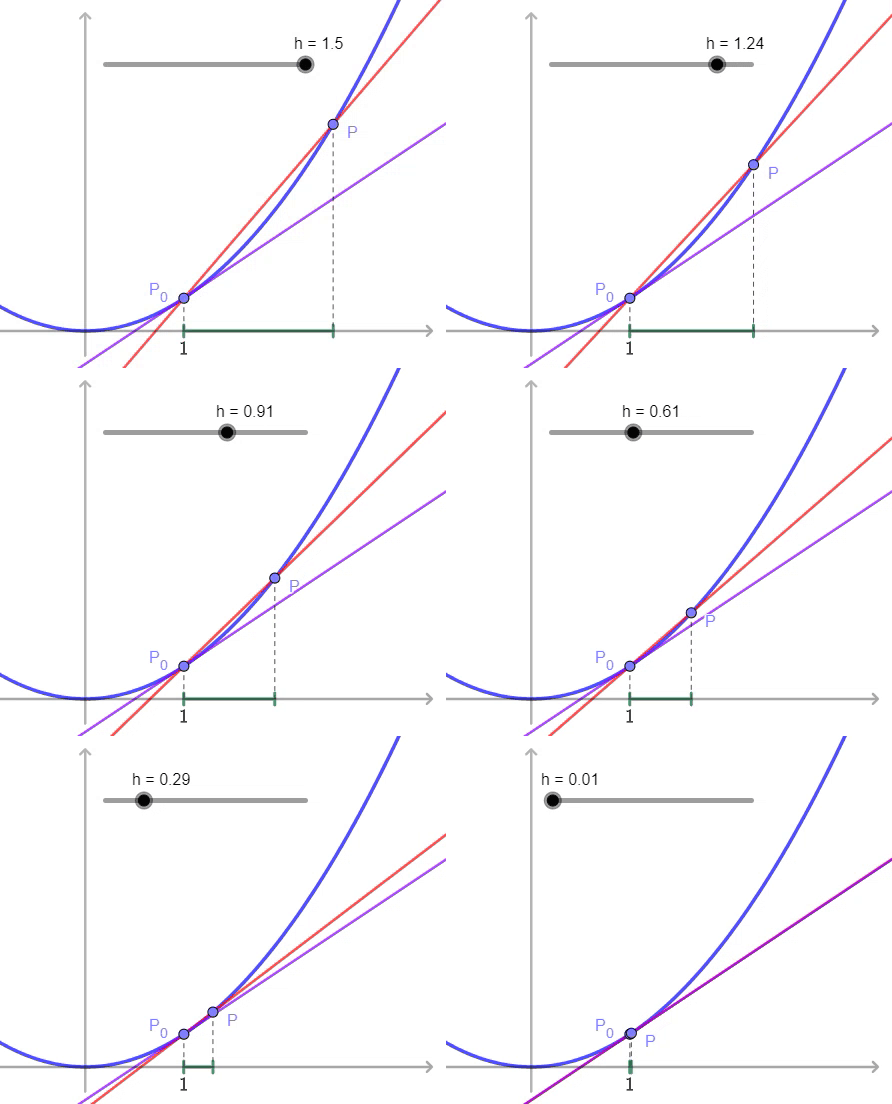
The Cartesian equation of the line \(r\) is given by: